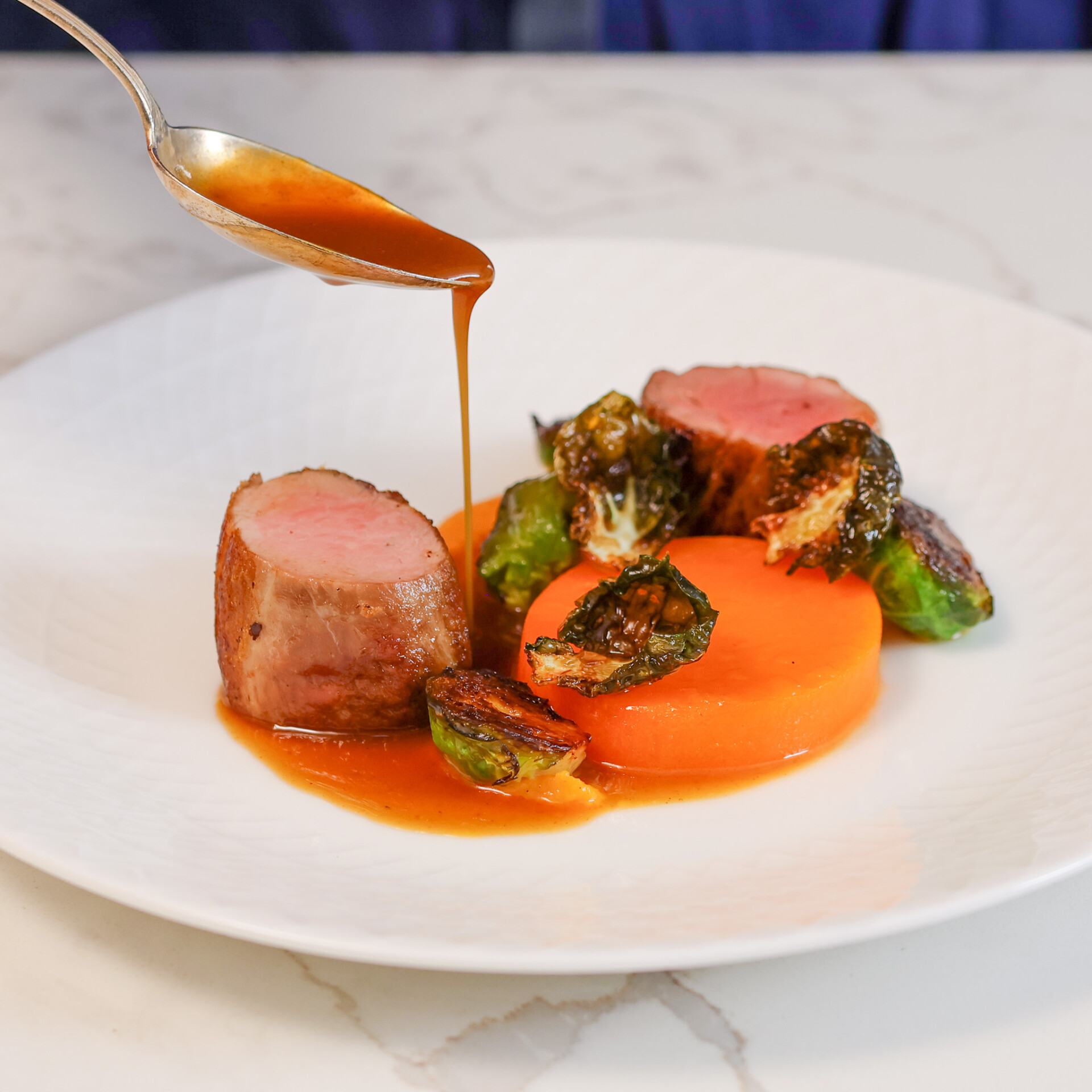
Weekday Michelin Techniques for Pork Tenderloin

Ingredients
Pork Tenderloin
- 2 ea Pork tenderloin
Pork Stock
- 900 g Pork neck bones
- Pork trim
- 450 ml Chicken stock
- 450 ml Brown veal or chicken stock
- 575 ml Water
Mustard Bourbon Sauce
- 50 g Shallots, thinly sliced
- 10 g Garlic, thinly sliced
- 30 g Dijon mustard
- 30 g Bourbon
- 1 sprig Thyme
Butternut Squash Rounds
- 1 ea Butternut squash
- 2 sprigs Thyme
- 1 clove Garlic, smashed
- 75 g Clarified butter
Butternut Squash Puree
- 75 g Butter
- 900 g Butternut squash, peeled and diced
- 2 ea Bay leaf
- t.t. Nutmeg
Brussel Sprouts
- 20 ea Brussel sprouts
- Chicken stock
- 30 g Butter
Instructions
Butcher
- To remove the silver skin, insert the tip of the knife underneath the silver skin and cut away. Holding the end, cut the other way to detach. Remove all the silver skin from the tenderloin, this will not break down during the short cooking time. I also like to remove any large pockets of fat.
- Most pork tenderloins won’t have the chain attached but if yours does, simply cut it away then cut away any silver skin. Cut the chain into 1-inch pieces and save for the sauce.
- Once nice and cleaned, cut a long piece of butcher’s twine, wrap the end, and then knot it. Loop the string around the meat and pull the string under. Be sure to keep the loop evenly spaced then tie off the other end. Cut the extra string and trim up the end, these will just overcook but save for sauce. Tying the meat helps to keep a nice uniform shape.
- I’m a big fan of seasoning larger cuts of meat early on. This creates an even season through the meat. Store this in the fridge to help dry the surface, which will help achieve a better sear.
Stock
- Split the bones in half by cutting through the joints. Cutting the bones into smaller pieces will require less cooking time.
- Heat a large, wide pan on medium-high heat. Add oil to coat the bottom of the pan searing the bones for 10 minutes, then flip the bones over. Add the pork trim and sear for another 10 minutes.
- Deglaze the pan with 225g of water, using a wooden spoon to scrape up all the fond. Reduce this which will cause the gelatin to start coating the bones. Cook out all the water. The bones will start to sizzle again, allowing them to deepen in color, and the fond will start to build back up on the bottom of the pan.
- Add 450 ml water, scraping any remaining fond from the bottom of the pan, then add 450 ml chicken stock and 450 ml brown veal or brown chicken stock.
- Bring this to a convection simmer, which will help push the fat and imputes off to one side. Use water to dip the spoon in to remove any impurities from the spoon and prevent adding them back in. Cook this for 45 minutes then strain and hold off to the side.
Butternut Squash Rounds
- For the butternut squash, remove both ends then split right above the seed cavity. Run your knife down the sides of the squash to remove the skin, then cut the neck of the squash into 1 in round.
- Using the largest ring punch that will fit, punch out circles. Place the circles into a cryovac bag with salt, 75 grams of cold clarified or whole butter, a couple of sprigs of thyme, and a smashed garlic clove.
- Seal the bag and place it in a water bath at 185 f / 85 c for 30 minutes or until tender.
- Remove the bag from the water bath and store it in the bag.
Butternut Squash Pure
- For the puree, dice up the butternut squash trim, you will need 900 grams worth.
- In a wide pan on low heat, melt 15 g butter. Add in diced squash, and season with salt. Place the lid on and sweat the squash for 10 minutes.
- Add 225 grams of water with two bay leaves, then add the lid back on and cook the squash until tender. Remove the lid and cook out all the water.
- Remove the bay leaves then blend until smooth. Add in 60 g cold cubed butter a little at a time. This helps to make the puree smoother. Season to taste with salt and nutmeg.
- Pass the puree, then store it off to the side in a warm spot
Sauce
- To make the sauce, add enough oil to barely coat the bottom of the pan.
- Add 50 grams of shallot, and 10 g garlic with some salt and sweat.
- Add 30 grams of dijon and cook for one minute to bring out more of the mustard flavor, then add in 30 grams of bourbon. If you are using a gas stove be sure to turn off the heat or you might burn off your eyebrows.
- Cook until au sec or until almost dry. Add in all of the pork stock with a sprig of thyme. Bring this to a convection simmer and remove any impurities, then cook on medium-high heat to reduce until nappe or sauce consistency.
- Strain the sauce into another pot then finish with a splash of bourbon. This is something we would do at Addison, it will help open up all the flavors in the sauce. Finish with a little butter to smooth out the sauce and add mouthfeel, then store this in a warm spot.
Glazed Brussels
- If you are getting Brussels sprouts during peak season, remove them from the stem with a pairing knife.
- Separate the sprouts into 3 containers, one for the dark leaves (which are tough and can be discarded) one for the larger inner leaves, and the last for the sprouts. Trim off the ends then split the sprouts in half.
- Heat a pan on medium heat, coating the bottom with oil. Lay out the sprouts starting from the rim, moving to the middle where it is the hottest, and season with salt. Once they become GBD, golden brown, and delicious, flip them over to cook on the other side for a minute.
- Add in enough chicken stock to go halfway up the sprouts then add in 30 grams of butter. Flip the sprouts back over, cooking the stock down until it is thick enough to coat the Brussels sprouts. Remove from the tray add more stock and slightly reduce if needed, then glaze the sprouts
Fried Leaves
- Heat a pot of oil to 325 f/ 162 c. Place the leaves in and cover with a lid. The water in the leaves will cause the oil to spray. You will know that the leaves are ready when the bubbles start to subside and the leaves turn GBD.
- Strain from the oil and place onto a paper towel to drain away any remaining oil. While the leaves are still warm, season with salt. This will help the salt to stick.
Al a minute
- For the pork, heat a large pan to medium-high. Once it starts to smoke, add enough oil to coat the bottom of the pan. Place the pork into the pan, Since we seasoned them early, there is no need to season them now.
- Cook the pork until it has a nice sear all around, about two minutes per side for a total of 8 minutes. Add 60 g of butter with one smashed garlic clove and a large sprig of thyme and baste the pork. Basting the pork not only helps develop a nice color to the meat, but it helps impart more flavor.
- Place the pork on a sheet tray with a wire rack then top with the butter, thyme, and garlic. Place the pork into a 300 F oven until you hit 135 F internal then rest in a warm spot.
- To reheat the food, place the butternut squash in the water bath, then place on a tray once warmed.
- Heat the puree and the sauce on the stove. Place the glazed brussel sprouts and plate under a low broiler.
- While everything is heating up, remove the string from the pork and portion.
Plate
- To plate, place the puree towards the back of the plate, using the back of the spoon, spread it out.
- Place the butternut squash round, the two pieces of pork, 5 Brussels sprouts, and 5 leaves. Place the sauce in the middle.