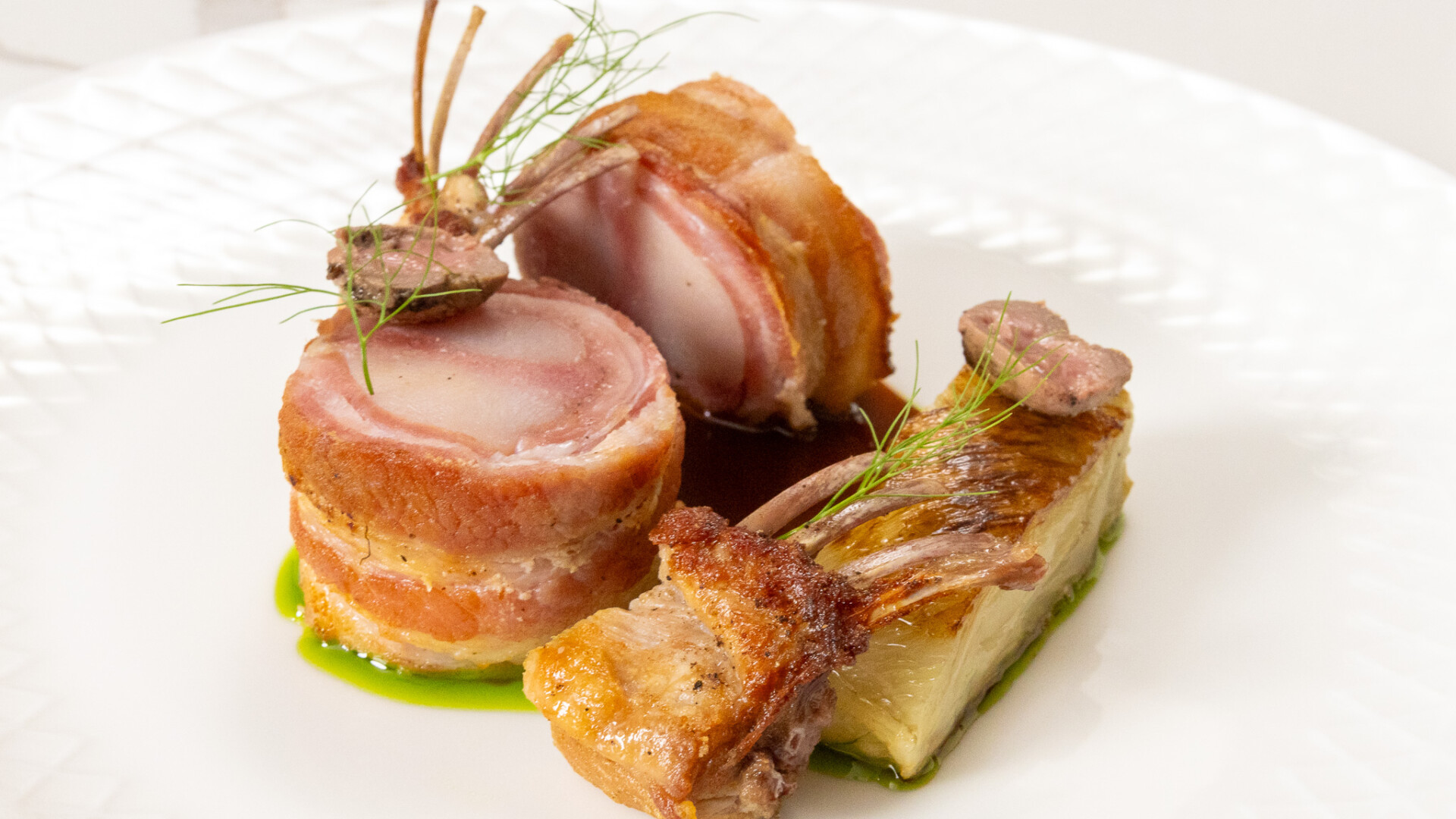
The French Laundry’s Rabbit

Ingredients
Rabbit
- 3 ea Rabbits
- 18 slices Bacon, preferably thin
Caramelized Fennel
- 3 ea Fennel bulbs
- 2 sprigs Thyme
- 2 ea Star Anise
- 1 tsp Fennel seeds
- 1 ea Bay leaf
- ¼ C Kosher salt
Fennel Oil
- 2 C Picked fennel fronds
- 2 C Picked parsley leaves
- 6 oz Avocado oil
Sauce
- 1 Lbs Rabbit bones
- 12 oz Water
- 10 oz Chicken stock
- 3 oz Onions, 1/2 inch dice
- 2.5 oz Carrots, 1/2 inch dice
- 2 oz Leeks, 1/2 inch dice
- 8 oz Veal stock
Rillettes
- 2 ea Rabbits legs
- 1 tsp Kosher salt
- 4 oz Duck fat, cold
- 2 ea Garlic cloves, smashed
- 1 ea Bay leaf
- 6 ea Black pepper corns
- 1 ea Star anise pod
- 4 ea Thyme, sprigs
- Splash Sherry vinegar
Instructions
Rabbit
- Feel where the joints are then cut in between the legs and the body. Bend the leg back to expose the joint and cut through, repeating on the other leg. Most likely, your rabbit will have the kidneys and the liver. For the kidneys, remove them, peel off the outer membranes and set aside. We do not need the liver for this dish.
- Separate the racks from the saddle by cutting in between the last two rib bones, and through the back. Remove the sternum, feel where cartilage is, and cut in between the cartilage and the ribs. Repeat this on the other side and pull. To remove the neck, cut in between the second and the third rib, then through the back. Remove any flap meat and using the tip of your knife, cut along the spine. Using kitchen shears split each rack lengthwise along the spine to form two individual racks.
- To french the racks, scrape the back of the ribs to break the membrane, then use the tip of the knife to cut in between the bone. Cut the bones so that they are even, then gently pull the meat away. You want to be careful with these toothpick sized bones, they can snap easily. Trim the rib meat away. On a cow, this would be a ribeye.
- For the saddles, use a sharp boning knife and remove the loins by cutting along both sides of the spine. This is the same as a New York strip. Use your fingers to remove any flap meat. Flip the back over and use the tip of the knife to release the tenderloin, then pull out, it will be quite small.
- Trim the flaps similar to flank steak, to 1 inch wide and the same length as the loins. Season the loins and tenderloins with salt and pepper, placing one loin on the bottom, two tenderloin in the middle with the last loin on top. The loins taper, so be sure to have one small end and one large end on each side. Fold the flaps around the meat to form a compact cylinder.
- Arrange 6 slices of bacon on a cutting board so that they slightly overlap and form a rectangle as wide as the length of the loins. Roll the rabbit loin up in the bacon, trimming away any excess. Tie with butcher's twine at 1 inch intervals, wrap the twine around the end, then go under the loops on the bottom. Tie the twine to tighten the end and make a cylinder. One rabbit is enough for two people.
Caramelized Fennel
- To make the caramelized fennel, trim the tops and root ends from the fennel bulbs, cutting an X into the root end of each. Place the fennel in a pot, covering with cold water. Add in 2 pieces star anise, 1 teaspoon fennel seeds, 1 bay leaf, 1.5 oz kosher salt and 2 sprigs thyme. Bring the water to a boil, covering with a lid, and simmer for about 45 minutes. You will know that the fennel is ready when you can easily insert a paring knife into the core.
- Use a slotted spoon to remove from the pot and refrigerate the fennel. When the fennel bulbs are cold, cut 2 center-cut slices, about ½ inch each, from each bulb.
Fennel Oil
- For the fennel oil, pick 2 cups each of fennel fronds and parsley, which is about 1 bunch of parsley and the fronds of two fennel heads. I like to store the parsley stems in the freezer and add them into my stocks. Same thing can be done with the fennel stems.
- Fill a pot with a large quantity of water and bring to a rolling boil. Add enough salt to the water so that it tastes like the ocean, 1 cup of salt for every gallon of water. This helps season the oil and also prevents the green pigment from leaching into the water. Cook the herbs for 10- 15 seconds, then shock in a bowl of ice water to stop the cooking.
- Once cooled, squeeze out all the water. It is easier to remove the water now than later. Since excessive blending can create friction, which will turn your oil brown, use scissors to cut the herbs smaller before blending. Scissors are better than a knife, which can cause some herbs to oxidize.
- Blend the herbs in two batches with just enough oil to cover. In total, you will need 6 oz oil. I used avocado oil but any neutral oil will work. To get the strongest flavored oil, store the herb puree for one day in the fridge before straining. Use a linen like or a coffee filter to strain.
Sauce
- To make the sauce, heat a wide pan large enough to fit the bones in a single layer over high heat . Once it begins to smoke, add enough oil to coat the bottom, I’m using avocado oil. Add in the bones, searing without stirring, for about 10 minutes. The recipe doesn’t state this, but from past experience with their quick sauce technique, I turn down the heat to medium high once I add in the bones to prevent burning. In order to develop a nice sear, do not move the bones around or you can cause them to release their juices creating more steam rather than sear.
- After the bones are GBD-golden brown and delicious, give the bones a flip. This is the point where I added in the excess trim. The bones will take about 10 minutes per side. Its important to get a good sear, this is how the sauce gets it's flavor. For the first deglaze, add 4 oz water to the pot, and using a wooden spoon, preferably a flat one, remove all the fond from the pan. Once the pan is au sec (almost dry) deglaze with 2 oz of chicken stock.
- As the stock reduces, the bones should deepen in color and the gelatin from the stock should start to coat the bones. For the mirepoix, cut 3 oz onion, 2.5 oz carrots and 2 oz leek into 1/2 inch pieces. Add the vegetables in, which will provide the liquid for deglazing. If you notice that the fond is dry on the pan, add in some of the water to prevent it from burning, which will add bitter flavor to your sauce. Cook until au sec and the vegetables are lightly caramelized.
- For the final deglaze, add the remaining 8 oz of chicken stock, 8 oz veal stock, and the remaining 8 oz of water. Scrape up any remaining fond from the bottom then bring to a simmer. Pull the pot half way off the burner to create a convection simmer, which will push all the impurities to the side. Use a spoon to scoop all the impurities off and into a cup with water. Dipping the spoon into the water will prevent incorporating the impurities back into the stock.
- Simmer for 30 to 45 minutes, skimming often, until the stock has reduced to the level of the bones. Strain the sauce through strainer into another bowl to separate the bones and vegetables from the stock. Double strain the stock into a clean pot and reduce by half or until nappe, to coat the back of a spoon. Double strain into a clean sauce pot and hold off to the side.
Al a Minute
- For the al a minute cooking, heat a pan over medium high heat, coating the pan in a thin layer of oil. Sear the saddles until GBD all around, for about five minutes. Transfer to a tray and place in the oven for 5-7 minutes or until cooked to medium.
- Clean out the pan and heat over medium high adding oil when it is hot. Season the racks and kidneys with salt and pepper, then add the racks to the pan. The book says to cook for 3-4 minutes but mine were well done, so I would stick to around 2 minutes. Add the kidneys into the pan during the last minute, flipping half way and then set both aside.
- Clean the pan out, heat on medium and add a thin layer of oil. Place the fennel slices in and sauté them until they are slightly caramelized, about 2 minutes per side.
- Remove the string from the saddles and cut into 4 even pieces. Slice the racks and kidneys both in half and set onto a tray with the fennel. Place under a low broiler with the plate until warm, 10-20 seconds while you warm the sauce.
Plating
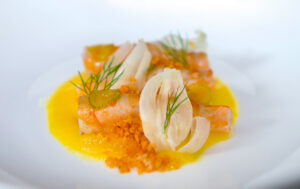
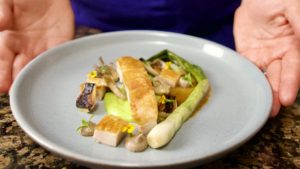
- Squeeze a ring of fennel oil onto each plate and spoon the sauce into the center. Place down the two slices of saddle and the fennel. Place down the two pieces of rack and kidney, finishing with fennel fronds. I plated up this dish slightly different than the instructions in the book.
Rillette (Bonus Recipe)
- Rub the rabbit legs with 1 tsp of kosher salt, then place them in a cryo-vac bag with 4 oz cold duck fat, 2 garlic cloves smashed, 1 bay leaf, 6 black peppercorns, 1 star anise pod and 4 sprigs thyme and seal.
- Place into an immersion circulator at 160f / 71c cooking for 4+ hours. Remove from the bag and strain the fat, then set off to the side. While still warm, shred the rabbit, then mix with 2 oz of duck fat and a splash of sherry vinegar. Place this into a stand mixer with the paddle attachment and mix until it is shredded.
- Using a damp towel, wipe your container and carefully lay the plastic wrap so that it does not bunch up. Add the rillette in an even layer, then roll into a cylinder, using the counter to shape. Tie off both ends and place into the fridge until firm, about two hours.This is great to serve as an appetizer with toasted brioche, mustard, cornichons and a fresh herb such as thyme.
Notes
1 Rabbit is enough for two people