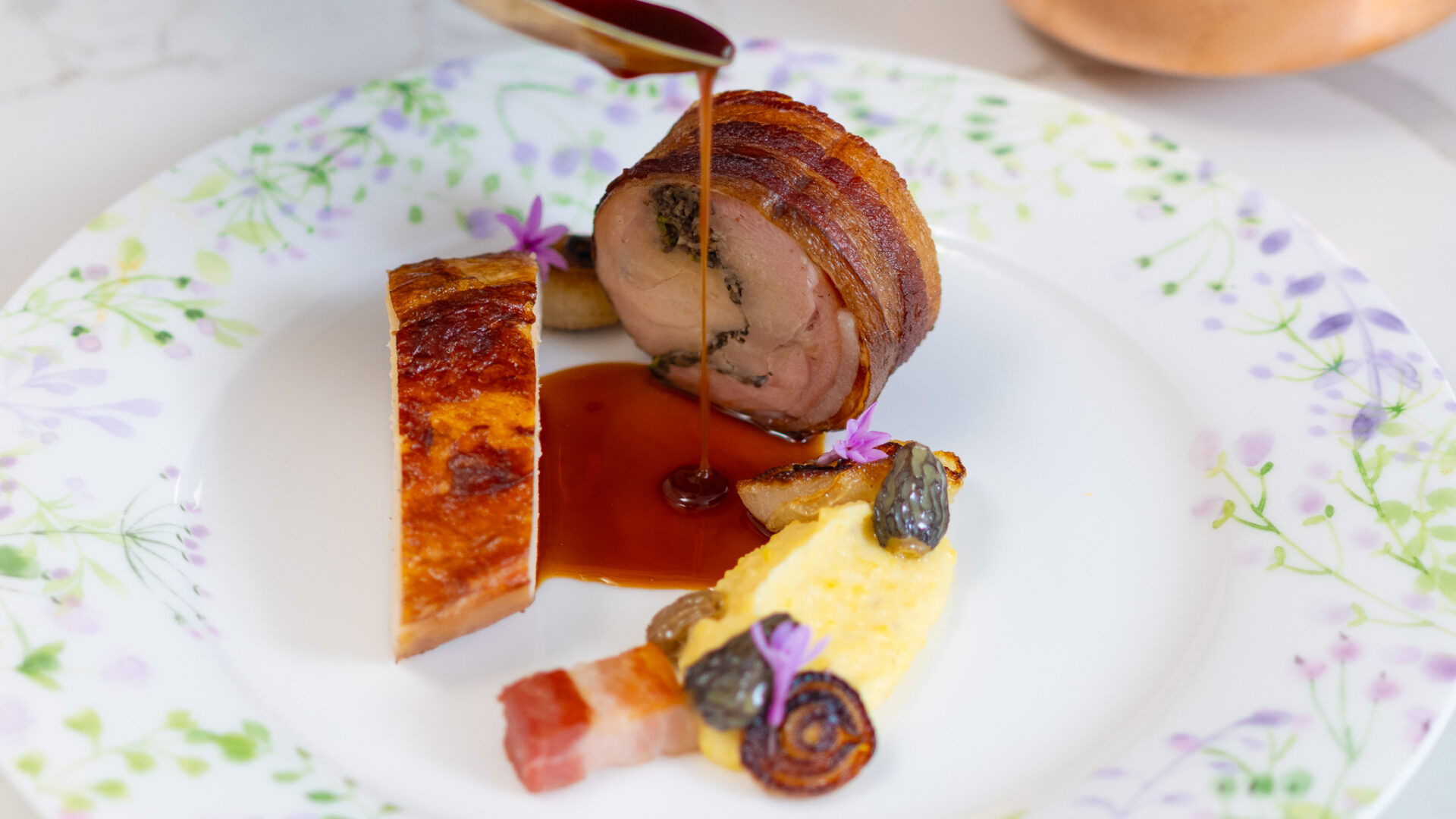
Modern “Coq au Vin”

We are taking the classic flavors of Coq au Vin and creating a modern fine dining version of the dish.
Ingredients
Rooster
- 2-3 kg Capon (5-7 Lbs)
- 12 Slices Bacon
Mushroom Duxcelles
- 20 g Butter
- 50 g Cremini mushrooms
- 20 g Shallot, minced
- 5 g Garlic, minced
- 1 g Thyme, picked
- 10 ml Cream
"Marinade"
- 5 g Rendered fat
- 20 g Shallot, thinly sliced
- 5 g Garlic, thinly sliced
- 5 g Tomato Paste
- 25 ml Cognac
- 240 ml Burgundy wine (sub: Pinot Noir)
- 1 sprig Thyme
- 1 ea Bay leaf
- 120 ml Chicken jus
Fortify Stock
- 700 g Capon bones
- 125 g Onions, 1/2 inch dice
- 90 g Leeks, 1/2 inch dice
- 135 g Carrots, 1/2 inch dice
- 750 ml Water
- 750 ml Chicken stock
- 500 ml Chicken jus
Sauce
- 120 ml Burgundy
- Red wine reduction
- Fortified stock
Polenta
- 350 ml Water
- 350 ml Cream
- 150 g Fine cornmeal
- 30 g Butter
- 30 g Parmigiano reggiano
- 25 g Crème Fraîche
Morels
- 24 ea Morels, small
- Creme, splash
- 113 g Butter, cold and cubed
Cipollini Onions
- 24 ea Cipollini onions
- 20 g Rendered rooster fat
Bacon
- 1 ea Bacon, 1 inch thick
Garnish
- 40 ea Garlic flowers
Instructions
Break Down the Bird
- Start by draining the bird, which I normally do in the sink with a colander or on a sheet tray with a rack.
- Start by removing both wings, being sure not to cut into the breast, then set them aside.
- Remove the legs by cutting the skin as close to the leg as possible. This will leave more skin on the breast. Bend the leg back to pop the joint, cut around the oyster, between the hip, and cut through. Repeat this on the other side and store it off to the side. Cut around the leg bones, then release at the ends. Cut around the knee joint to release the meat from the bone. Remove the skin, we will save this for later, then trim away any pockets of fat and remove any cartilage.
- Remove the breast by cutting along the keel bone, then following the rib cage. Flip the breast over to remove any cartilage, remove the tendons, which will allow the breast to sit better on the plate, and trim up any pockets of fat or excess skin. Separate the ribcage from the back, remove any skin from the back, and cut the bones into large pieces.
- Separate the leg bones but cutting between the joints, and do the same for the wings. We will need 700 grams of bones for the sauce later. If you end up with more bones than you need, like I did, save the high-collagen bones, wings, neck, and backs for stock for later.
Duxcelle
- Thinly slice 50 grams of crimini mushrooms, cut lengthwise the other way, then rotate and cut into small pieces. Run your knife through the mushrooms to make sure all the pieces are even.
- Heat a pan on medium heat and melt 20 grams of butter.
- Add the mushrooms to the pan and season with salt.
- Once all the water is cooked out of the mushrooms, add 5 grams of garlic, 20 grams of shallots, and 1 gram of picked thyme and cook for one minute.
- Add the cream, cooking until it is fully reduced, about 20 seconds.
- Transferred to a tray and spread out to cool down the duxelles.
Roll the Roulade
- Place the leg meat on the board in a rectangular shape with the short end facing you. Season the leg with salt and spread out the mushroom duxelles, then roll the leg tightly to form a cylinder shape.
- Shingle 5 slices of bacon, alternating the slices so that they lay evenly. Wrap the roulade in the bacon, trimming the excess so that the bacon just barely overlaps.
- Wrap the roulade in cheesecloth, rolling it tightly to shape it. Tie both ends of the roulade, being sure to have extra string. Wrap the string towards the roulade to compress it and give it a nice shape, then tie it off. Trim the excess cheesecloth and string to make everything look nicer.
Render Fat
- To render the fat, add all the fat to a pot and cover with water. Bring this to a simmer and skim off any protein that floats to the surface.
- Let this render on low heat until all the water is cooked out, about 45 minutes. Strain the rendered fat into another container and cool in the fridge.
“Marinade”
- For the marinade, add 5 grams of rendered fat to a large pan over medium-low heat and sweat 20 grams of shallots with 5 grams of garlic, both thinly sliced.
- Add 5 grams of tomato paste, cooking for 30 seconds to enhance the flavor of the tomato paste.
- Then add 25 ml Cognac to deglaze, being sure to turn off the heat if you are using a gas stove so you don’t burn your face off. Cook until au sec or almost dry, and add in 240 ml of Burgundy wine. If you can’t find Burgundy wine, a good substitute is Pinot Noir from another region.
- Add in 1 sprig of thyme with 1 bay leaf and reduce the wine on low by 2/3s.
- Add in 120 ml chicken jus, and reduce by half. Strain the marinade, pressing on the aromatic to extract as much marinade as possible, then chill.
Sous Vide the Legs
- Roll down the tops of two cryovac bags, this will keep them clean, and add a fourth of the “marinade” to two small bags and place in the roulade. Roll up the bag and seal, then place it into a water bath at 145°F or 63°C, cooking for 6 hours.
Sous Vide the Lardons
- Cryovac a 1-inch-thick piece of slab bacon. I got this from my butcher. Cook this alongside the roulades for 6 hours.
Sous Vide the Breast
- Roll the top down on a cryovac bag and place the remaining marinade in. Season the breast with salt and add the breast to the bag and seal.
- After the roulades have cooked for 3 hours, add the breasts in, and cook for 3 hours so they finish at the same time as the legs. Remove both the legs and breast from the bag, over a rack to separate the liquid, leaving the bacon in the bag to cool in the freezer. Reserve the marinade for the sauce.
Fortify the Stock
- To make the stock, heat a large pan over medium-high heat, adding enough rendered fat to coat the bottom of the pan.
- Add the bones in a single layer, cooking until GBD golden brown and delicious, about 10 minutes.
- Flip the bones and repeat, making sure the fond doesn’t start to burn. The second side might take a little less time than the first side.
- Deglaze with 250 ml of water, scraping up the fond as the water reduces. As the water starts to cook out, the gelatin from the bones will start to glaze the bones, and the bones will start to sizzle again, deepening in color, and start to build the fond again.
- Add in 250 ml of chicken stock, scraping up all the fond. Cook until the pan is almost dry, then add the 125 grams of onions, 90 grams of leeks, and 135 grams of carrots, all cut into 1-inch pieces, and cook for 1 minute.
- Deglaze with 500 ml of water, scraping up all the fond, then add 500 ml of both chicken stock and chicken jus. Bring the pan halfway off the burner to create a convection simmer, which will push all the impurities off to the side, then use a spoon to remove them. I like to use a cup with warm water to remove any impurities from the spoon. Cook this for 45 minutes at a low simmer, then strain and hold off to the side.
Sauce
- To make the sauce, add 120 ml of Burgundy wine to a pan and bring to a simmer. Turn the heat to low and reduce by half.
- Remove the fat from both the reduction and the fortified stock. It helps if you cool them down first, then scrape all the congealed fat off the surface. Add both the reduction and stock to the pan and bring to a simmer.
- Turn the heat to high and pull the pan halfway off the burner to create a convection. Using a spoon, remove all the impurities that float to the top.
- For the marinade, strain through a linen-like, to remove all the particles. (I did this differently in the video, but this is the better way). Add the strained marinade and foriitfied stock to the pan and reduce to a sauce consistency or until the sauce is thick enough to coat the back of a spoon. Finish with 10 ml sherry vinegar and 20 grams of cold cubed butter, a little at a time.
Creamy Polenta
- For the polenta, add 350 ml each of cream and water to a pot with 150 grams fine cornmeal and whisk.Turn on the heat to medium, stirring constantly to prevent anything from sticking to the bottom, and bring to a simmer.
- Turn the heat to low and, place a lid on top, cooking until all the polenta is tender, about 10 minutes.
- Add 30g cold cube butter, 30 grams of finely grated Parmigiano Reggiano, 25 grams of crème fraiche and seasoning with salt. Stir until fully mixed in, then store with the lid on in a warm spot.
Morels
- Trim the stem if needed, then rinse the morels in a bowl of cold water to remove all the dirt (warm water will cook the mushrooms). Repeat this process until the water is clean after rinsing about 3 times, then place them onto a tray with a paper towel.
- Place enough cream to just coat the bottom of a small pot and bring to a boil. Turn the heat to low, then whisk in 113g (1 stick) of cold cubed butter a little at a time until it is fully emulsified and season with salt.
- Add in the mushrooms and gently cook until they are tender, and store in a warm place.
Caramelize Onions
- Remove both the root and stem ends from 24 small cipollini onions and peel. Any large cipollini can be cut in half and counted as two.
- Heat a pan on medium heat and add in 20 grams of rendered fat, then lay the onions in and season with salt. Cook the onions until they are golden brown, then flip, and cook until tender, then remove.
- For any whole onions, leave them in the pan and add some water. This will help steam the onions, ensuring that they are fully cooked. (I think the smaller onions look nicer)
Sear Bacon
- Remove the bacon from the cryovac bag and remove all the fat and gelatin. Cut the bacon into ½ inch wide pieces.
- Heat a dry pan on medium-low heat, and add the bacon. Cook the bacon until it is crispy, 3 – 5 minutes, then flip the bacon and repeat on the opposite side. Transfer this to a tray.
À La Minute
- For the roulade, cut away both ends of the cheesecloth, then unwrap. Heat a dry pan on medium-low heat and sear the roulade until the bacon is crispy, about 30-60 seconds per side. Rotate the roulade and continue to cook until it is golden brown all around, then set it onto a tray.
- Sear the breast skin-side down until golden and crispy, about 3- 5 minutes, then place onto the tray with the roulade and place into a 300°F or 148 °C oven until you reach an internal temperature of 160°F or 71 °C. Remove the ends from the roulade, then slice into 4 pieces.
- Trim the ends off the breast and slice into four pieces at a slight bias.
Plate- flower plate
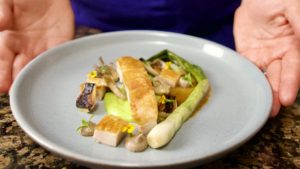
- To plate, place the breast between 7 & 8 o’clock with the roulade at 10 o’clock. Add a soft quenelle of the polenta at 3 o’clock with one piece of bacon at 5. Place down 3 onions and 3 morels with the sauce in the center and garnish with garlic flowers.